The design of an industrial hall is a complex process involving various disciplines and tools.
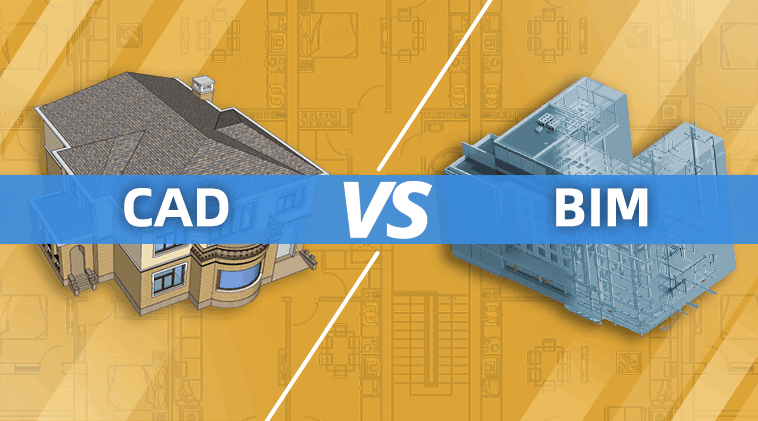
The most widely used today are CAD -Computer-Aided Design- and BIM -Building Information Modeling. Although both systems are used in the field of engineering and architecture, they have significant technical differences that affect how projects are managed and implemented.
Representation and management of information
CAD: 2D drawing and 3D modeling
Geometric representation: CAD is based on the geometrical representation of elements. Designers create 2D drawings or 3D models that represent the individual parts of a structure.
Layers and blocks: Use layers to organize information, allowing you to turn on or off the display of certain elements. Blocks are reusable geometry sets that can be inserted into different parts of the design.
Limited data: Additional information on design elements, such as materials or technical specifications, is usually added by annotations and not inherently linked to geometry.
BIM: Parametric Modeling and Integrated Data
Parametric modeling: BIM uses parametric objects that represent real building elements. Each object contains detailed information about its physical properties, materials and relationships with other elements.
Centralized database: The information in the modeling software is managed through a central database that stores all project data. This includes not only geometry, but also information on materials, costs, scheduling, and maintenance.
Interoperability: BIM facilitates interoperability between different disciplines thanks to standards such as IFC (Industry Foundation Classes)The project is now being implemented in a number of countries.

Design and documentation process
CAD: Linear and sequential processes
Linear workflow: The design process in CAD is generally linear. Drawings and plans are created in a logical sequence, from initial sketches to detailed construction drawings.
Separate documentation: Each stage of the design produces separate documents-drawings, sections, elevations-which must be coordinated manually to ensure consistency and accuracy.
Manual update: Changes to the design require manual updates on each affected document, which can be error-prone and time consuming.
BIM: Iterative and collaborative processes
Iterative workflow: This program allows a more iterative and collaborative design process, where changes can be made at any stage of the project and are automatically updated throughout the model.
Integrated documentation: Documents and drawings generated from a BIM model are always synchronized. A change in the model is automatically reflected in all related views and documents.
Coordination and collaboration: The centralized and parameterized nature of the software facilitates collaboration between different teams and disciplines, The Commission’s proposal for a Council Decision on the European Union’s Social Charter is based on the principle of subsidiarity.
Simulation and analysis
CAD: Limited analysis and simulation
Basic capabilities: CAD analysis capabilities are generally limited to external tools and are not directly integrated into the design process.
Additional software dependency: To perform complex analyses, such as structural or energy efficiency simulations, it is necessary to export the designs to specialized software, This may mean errors and coordination difficulties.
BIM: Integrated simulation and analysis
Integrated analysis: This software incorporates analysis tools directly into the model. This includes structural, thermal, lighting, and cost analyses, among others.
Design optimization: Simulation and analysis capabilities allow you to optimize design at an early stage of the project, improving efficiency and reducing construction costs and time.
Concluding... While CAD focuses on creating detailed geometric representations, BIM provides a more integrated and collaborative platform, It incorporates data and analysis into the design process, offering a more complete and accurate view of an industrial hall project.